

Moles are a persistent pest problem in the Bay Area.
Drawn to the region’s rich, moist, grub-rich soil, these little pests can quickly destroy lawns, paver patios, gravel beds, and landscaping.
Unfortunately, California law can make controlling these critters especially difficult, since many DIY methods that may work elsewhere are illegal or restricted here.
The good news? You’re not alone in the process.
Here at Smith’s Pest Management, we’ve helped thousands of homeowners throughout California remove moles from their property.
In this post, we’re sharing the exact strategies we use in the field to get rid of moles.
Key Takeaways
- California has strict laws around mole control. Trap-and-release tactics are illegal, and some poisons are restricted or prohibited.
- The most common mole in the Bay Area is the broad-footed mole (Scapanus latimanus), and the most effective method to get rid of them is to set traps in active tunnels. Spring and fall are the best times to trap.
- Prevent future mole damage by controlling grubs. Keep lawns healthy, and use barriers to make your yard less inviting. For ongoing problems, work with licensed pest control technicians who can identify active tunnels, develop a targeted mole control plan, and help reduce future damage.
- Serving Bay Area homeowners from Marin to Monterey for over 20 years, Smith’s Pest Management is here for you. Our owner, Zach Smith, is a Cal Poly Horticulture graduate and former landscape professional who dealt with burrowing pests for nine years before founding Smith’s, so you can trust us to deliver the burrowing pest expertise you need to reclaim your space.
How to Get Rid of Moles: 5 Effective Ways
1. Traps
Trapping is the most reliable method to get rid of moles.
Modern mole traps, including harpoon traps and scissor-jaw traps, use lethal methods to kill moles and quickly eradicate mole populations.
They also offer a high degree of target-specificity for moles and no potential for chemical buildup or secondary poisoning in the surrounding ecosystem.
Keep in mind that trapping moles requires consistency and creativity.
Moles are smart, and they, more than many other small mammals, are excellent at detecting and avoiding traps that aren’t set or placed properly.
How to do it:
- To make your trapping efforts as effective as possible, we recommend placing traps directly in active mole runways and trapping during the spring and fall, when moles are most active.
- Trapping during the spring allows you to eliminate females before they give birth to young, which is an effective way to limit infestations.
- Use about 3-5 traps per acre of property.
- If possible, you should seek to place at least one trap in each of the moles’ main runways. Mole runways are pathways the critters use again and again, so setting the traps in or near them improves the efficacy of your trapping program.
- You can find runways by poking holes into the top of the soil near a mole hole using a stick or your index finger. If the hole is repaired within a day or two, it’s a prime runway and a great place to trap moles.
California Regulations:
Although trapping moles is legal for California homeowners, there are some important rules to be aware of.
First of all, it’s illegal to release trapped moles in a new environment, so you must either let them go on the same property or euthanize them humanely.
Steel-jaw leg-hold traps are also banned in California.
While homeowners don’t need a license to trap moles on their own property, anyone trapping moles professionally must have the required license under California Fish and Game Code Section 4005(f).
Bay Area Tip: Moles are most active in spring and fall when soil is moist. Trapping during spring can eliminate females before they reproduce.
2. Baits
Baiting involves using poison to kill moles in their burrows.
Generally speaking, there are three different types of mole baits available: grain baits, gel baits, and synthetic worm baits.
They’re not all created equal, though. Here’s what you need to know:
- Grain pellet bait formulations have shown inconsistent results, since their efficacy is highly dependent on both the area and the mole species present.
- First-generation anticoagulant chlorophacinone pellet baits can be effective at certain times of the year, but they require repeated applications and may take as long as six weeks to eliminate mole populations.
- Earthworm-style baits containing the rodenticide bromethalin are generally considered the most effective since these baits can kill moles after a single feeding. Moles that eat earthworm-style baits die about 12-24 hours after a single ingestion. Additionally, earthworm-style baits tend to be enticing to moles since soil invertebrates are the main dietary staples for moles.
One of the benefits of baits is that poisoned moles typically die underground in their tunnels, so you won’t have to find and dispose of their bodies.
How to do it:
- Repeat bait applications every week for up to six weeks.
- Consider using high-success bait formulations, like gel baits that contain the anticoagulant ingredient warfarin.
- If you want a faster-acting bait, look for synthetic worm baits that contain bromethalin, which can kill moles in as little as 24 hours with just one feeding.
- No matter what kind of bait you use, you can make it as successful as possible by inserting baits directly into mole tunnels.
California Regulations:
This is where California law has seen some big changes:
Under AB 1322 (passed in 2023) and AB 2552 (effective January 1, 2025), anticoagulant rodenticides, including Diphacinone, Chlorophacinone, and Warfarin, are now prohibited throughout most of California.
This means that products that were once available to homeowners can now only be purchased by licensed pest control dealers.
The bottom line? Most mole baits are no longer available to Bay Area homeowners, although licensed applicators may still be able to use them.
3. Eliminate mole food sources
When you eliminate the grubs and other insects moles feed on in your yard, you make the habitat less attractive for moles.
We recommend controlling grub populations by using beneficial nematodes or milky spore to kill grubs. If you want faster results, use an insecticide instead.
Bay Area Tip:
Thanks to the Bay’s Mediterranean climate, grubs are active in lawns year-round. If you’re going to apply beneficial nematodes, keep in mind that they work best when soil temperatures are between 15-20°C (59-68°F), which is usually spring and early fall in the Bay Area.
4. Create dig-proof barriers
To form a human-made boundary around your lawn and garden, dig a trench that is roughly 2 feet deep and six inches wide around the space you’d like to protect.
Fill the trench with rocks or line it with wire mesh or hardware cloth with holes ¾ wide or smaller.
This is a time-consuming but effective, long-term solution to keep moles from burrowing their way into your yard.
You can also install gopher wire or gopher baskets under your lawn and around your newly planted landscaping items to keep moles from digging through the moist soil surrounding the roots.
Bay Area Tip:
Hillside properties are common in Oakland, Berkeley, and Marin, and can present unique challenges, since moles can burrow into slopes that are difficult to trench around.
For these properties, gopher wire and baskets can be effective when installed properly.
5. Keep your lawn tidy

Moles feel safest under cover.
Because of this, eliminating their shelter is a great way to encourage them to go elsewhere.
Here’s what to do:
- Mow Regularly: Keep your lawn well-maintained by mowing often. This improves the appearance and helps prevent moles, as they prefer longer grass.
- Avoid Overwatering: Don’t overwater your lawn. Excessively moist soil attracts insects and grubs, which moles eat. Water your lawn deeply but not too often.
- Fill Tunnels: If you see mole tunnels, fill them in right away. This can stop moles from coming back or making new tunnels.
- Install Barriers: To keep moles out, dig trenches around your lawn’s edges and fill them with rocks or wire mesh.
Remember that most lawns only need about an inch of water per week to stay healthy, so this approach won’t make your outdoor space any less beautiful.
What to Use as a Last Resort
If you’re really struggling to get rid of moles, you can turn to fumigants.
These should only be used when nothing else works, though. Fumigants can be highly toxic, and some can kill wildlife or other animals that enter treated burrows.
Fumigants can also be dangerous for humans if you breathe them in or use them without the right training and safety equipment. For that reason, it is best to leave fumigant treatments to trained professionals instead of trying to handle them yourself.
If you’re going to use fumigants, though, you need to know that, at the time of this writing, fumigants are highly regulated in California.
While some gas cartridges may be legal for homeowner use, restrictions vary by county and product. To learn more about the laws in your area, contact your local Fish, Wildlife, and Parks office.
Currently, there are two fumigants federally registered to control moles:
Aluminum phosphine tablets and gas cartridges.
That said, fumigation can produce inconsistent results when used to control moles, and there’s no way to confirm that you’ve killed the mole.
To ensure successful fumigation, insert any fumigant you use deep into the mole tunnel, and only use fumigants when the soil’s moisture content is high enough to contain the gas within the tunnel.
You may also need to apply repeated or large doses of fumigant, which makes this conventional control method drastically more expensive and time-consuming than trapping or baiting.
Important Laws and Regulations

In California, mole control is regulated to protect the environment and treat wildlife humanely.
Here’s what you need to know:
AB 1322 and AB 2552
California has some of the strictest rodenticide laws in the country.
Recently, laws including AB 1322 and AB 2552 have placed significant restrictions on certain anticoagulant rodenticides, including products containing diphacinone, chlorophacinone, and warfarin.
These chemicals pose a risk to wildlife such as hawks, owls, coyotes, and mountain lions that may eat poisoned rodents.
What this means for homeowners: Always check the current California regulations here before using a mole bait or other rodenticide. Some products may only be available to licensed professionals, while others cannot legally be used in California.
Trap and Release Laws
Like gophers, moles are considered an “unclassified” species according to federal law, which means that people can trap and kill moles that are damaging crops or property.
That said, the California Department of Fish and Wildlife (CDFW) manages the rules for trapping and relocating moles. According to state guidelines, it is illegal to use certain traps, like steel-jaw leg-hold traps, because they cause unnecessary suffering.
It also prohibits relocating nuisance wildlife, including moles, in the state. This means that, if you trap a mole, you cannot simply drive it to a park or another property and release it. Instead, trapped moles must either be released back onto the immediate property or killed humanely in accordance with California regulations.
This also makes trap-and-release an impractical DIY solution. Many animal control agencies will not accept trapped wildlife, and the California Department of Fish and Wildlife does not relocate wildlife. Before trapping, you should understand the rules and have a legal plan for handling the animal.
Licensing Requirements
Homeowners generally don’t need a trapping license to trap moles on their own property under Fish and Game Code Section 4005(f).
However, professional trapping requires a license, and some cities may mandate additional permits.
Rodenticides classified as restricted materials also require the appropriate licensing and are generally limited to licensed pest control professionals.
How Exterminators Deal with These Pests

If DIY is not your style, you may want to call in a professional mole control team like Smith’s.
Here are a few tactics our team here at Smith’s Pest Management uses:
1. Mole Trapping
As a locally owned and managed company with more than 15 years of experience in burrowing pest control, we understand Bay Area moles and the landscapes they live in, which is why we rely so heavily on trapping.
The Smith’s team will inspect your yard, identify the most active mole runways, and place no-kill traps accordingly. We tailor our approach to your specific property, whether it’s a hilly lot in Oakland or an open field in San Jose.
Trapping reduces your existing mole problem, and when you opt to participate in our annual mole control program, it can prevent moles from coming back in the future.
Since moles get very active in the winter when soil moistens up, good mole control is best done with trapping or Talpirid worms.
2. Grub Control
Eliminating the moles’ food source is the best way to ensure long-term control.
Fortunately, Smith’s provides comprehensive grub control services using granular lawn treatments that are fast, easy, and effective.
Because we use a granular lawn treatment, this option is fast, easy, and straightforward.
3. Exclusion
A popular, humane, no-kill method of mole control, exclusion relies on techniques that make it difficult for moles to enter your yard.
Gopher baskets and gopher wire can be particularly useful. While Smith’s does not provide mole exclusion services, the team can advise you on the methods that may work for you.
4. Annual Mole Control
For ongoing problems, we recommend our annual mole control program to keep your yard protected year after year.
Each year, we’ll return to your property and help address and eliminate ongoing or recurring mole problems.
This is the most effective way to maintain a healthy, green lawn for years to come.
Professionals like Smith’s Pest Management know how to get rid of persistent moles that keep coming back to your yard.
A Word About Our Warranty and Guarantee
We stand behind our work. Our one-time mole control services include a 30-day warranty, which means that if moles return within 30 days, we’ll come back until they’re gone.
Moles Destroying Your Bay Area Yard? We’re Here to Help -Legally and Effectively.
Smith’s Pest Management helps residential and commercial properties in Northern California reduce, control, and eliminate their mole problems through our mole control services.
We service Marin County, Santa Clara County, Santa Cruz County, and more!
Smith’s also works with parks and large facilities to eradicate moles in an eco-conscious way.
Contact us to request a free mole control quote today: (408) 871-6988.
FAQ
What are moles?
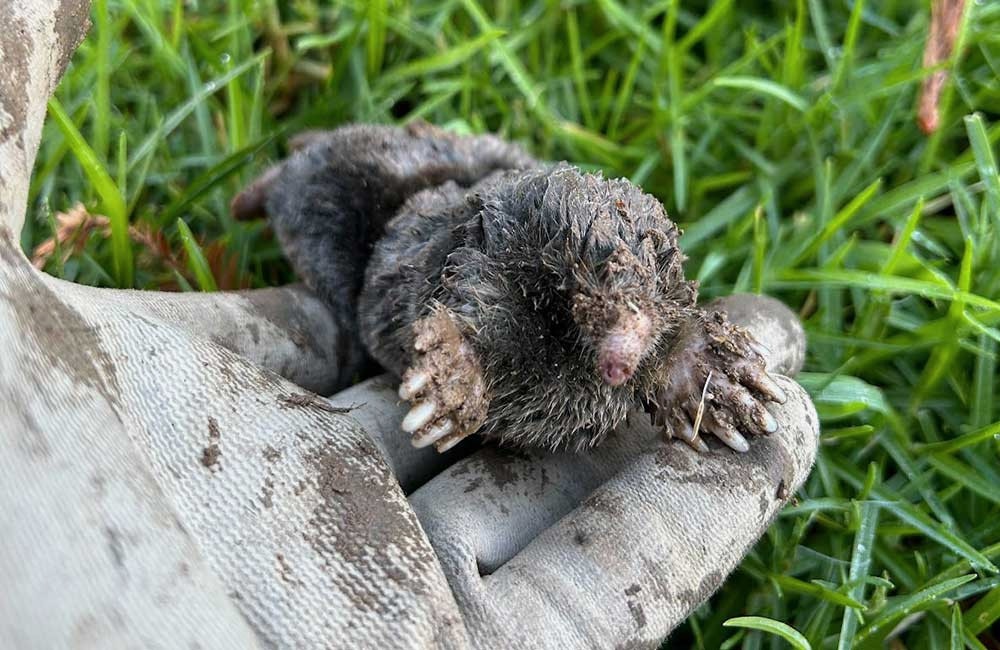
Moles (members of the family Talpidae) are small, burrowing mammals with cylindrical bodies, dark, velvety fur, and powerful forelimbs with large, outward-facing claws.
Common species of moles include the Townsend’s mole, which is widespread along the Oregon and Washington coast, and the broad-footed mole, which we see often in California.
Their close relatives include shrews and hedgehogs.
While you may see mice or ground squirrels darting across your yard, it’s unlikely that you’ll see moles very often. That’s because they spend most of their lives underground, digging constantly in search of food.
Because of this, one of the most obvious signs of mole activity is the presence of raised ridges and mounds of soil in your lawn or garden.
Contrary to popular belief, moles don’t eat the roots of plants and trees, although they do tunnel around and beneath them and create dirt piles in your yard.
Instead, moles are insectivores, so their tunnels are often concentrated in areas with plenty of earthworms and grubs.
What is the difference between moles and other animals?
Moles, voles, and pocket gophers all dig and cause damage, but they have several important differences.
If you’re going to get rid of moles, you need to be able to differentiate them from other burrowing critters.
| Moles | Voles | Pocket Gophers | |
| Appearance |
|
|
|
| Habitat |
|
|
|
| Diet |
|
|
|
| Damage Caused |
|
|
|
Still not sure how to differentiate moles from other digging critters? Check out our video on how to tell a molehill from a gopher hole.
What attracts moles to your yard?

These pests live their entire lives in their mole tunnels, so they’re more likely to frequent areas that offer the ideal habitat for feeding, breeding, and burrowing.
Here are three environmental factors that moles love:
- Lots of Insects. Moles eat a lot of bugs. In fact, the NWF reports that many species eat up to 100% of their body weight in insects each day. Studies have shown that a mole’s diet consists of earthworms, white grubs, beetles, and larvae. Moles will construct elaborate burrows in areas where these insects are abundant.
- Cool Temperatures. Contrary to popular belief, moles are not blind or nocturnal. They’re active throughout the day and prefer moist, cool soil that helps them regulate their temperature.
- Landscaping Elements. The main runways moles construct tend to follow certain landscaping elements, like fence rows, paths, or other human-made borders. They may also pop up along a line of hedges or another protected area. Moles will also burrow under shrubs and trees to locate the insects that live in their root systems. Wherever moles set up shop, food is the primary motivator—because of this, controlling their food sources is one of the most effective ways to control the mole populations.
What does mole damage look like?

While mole damage may seem similar to the damage caused by voles, mice, or rodents, some key differentiators exist.
Here are five signs to look for:
- Dead Grass. As we mentioned in a previous blog on the topic, patches of dead grass are a good indication that you have a mole problem. As these pests dig mole tunnels, they disrupt the root systems of nearby grasses, killing the grass at surface level and leaving dead patches in their wake.
- Molehills. Have you ever heard the saying, “making a mountain out of a molehill?” When moles dig their tunnels, they act like mini excavators, moving all that dirt out of the mole tunnel and up to the surface, creating a telltale, mounded molehill at the tunnel entrance.
- Mounds That Are Far Apart. Moles aren’t the only creatures that make entrance and exit mounds. Gophers do something similar. However, the difference is that gopher mounds are close together, while molehills tend to be about six feet apart.
- Chunks Of Dirt. When gophers dig in your yard, they pulverize the soil into a smooth powder. Moles, on the other hand, dig the earth up in chunks. As you evaluate the mounds in your yard, look for clumps of soil, which is a surefire sign of moles. If you’re wondering whether you have moles in your landscaping, it’s equally important to know what not to look for. Since moles are insectivores, they don’t chew plants or root systems. Instead, they eat earthworms, grubs, and centipedes. If you notice gnaw marks on your garden plants or vegetables, it’s likely that voles or mice are responsible – not moles.
- Surface Runways. Surface runways are feeding tunnels that moles create just below the surface of the soil. Usually, they look like raised ridges in a lawn area where moles are present. They typically do not have mounds attached to them. Thanks to their proficient digging abilities, moles are capable of digging up to 100 feet of surface runways each day. While moles travel through some of their surface runways every day, others are only used for occasional feeding.
“The reason that moles kill grass is that the lawnmower runs over these piles over and over again, spreads them out, and the grass below just gets smothered and dies, and then you get big dead patches.” – Zachary Smith, owner of Smith’s Pest Management.
What safety considerations should I keep in mind?
1. Safeguard toxic materials
If you are using poison to control moles, always store them in an area that is inaccessible to children, pets, and non-target animals, such as a locked cabinet, and ensure they are clearly labeled.
2. Understand and follow product guidelines
Read the labels on all used pesticides and rodenticides thoroughly and adhere strictly to the application instructions provided for your safety and to effectively address the mole problem.
3. Protect yourself
Don personal protective equipment such as safety goggles, gloves, and protective clothing when handling mole baits or removing mole remains after trapping to prevent any direct contact with hazardous substances.
4. Choose your treatment option
Choosing the right way to handle moles can be tricky for homeowners wanting to protect their lawns and gardens.
Compared to other urban wildlife, moles are actually pretty tough to control.
To deal with moles, homeowners have two main options: trapping and baiting.
Other methods exist but aren’t as effective as these options.
Here’s how to select the best option
- Assess your property size and landscape: Larger properties may require more extensive solutions (like large-scale baiting or trapping programs), while smaller yards might be manageable with less intensive approaches.
- Evaluate the effectiveness of various methods: Research and compare the effectiveness of different control options, including traps, poisons, and natural deterrents.
- Professional assistance vs. DIY: Decide whether you want to tackle the problem yourself or hire a pest control professional like Smith’s for quicker and more efficient results.
What is the fastest way to get rid of moles?
The fastest way to get rid of moles is through trapping. Live or kill traps remove mole populations rapidly and are excellent ways to deal with even a severe mole problem.
If you want an even more rapid solution, pair trapping with other methods, such as exclusion and deterrents.
How do I get rid of moles humanely?
You have many options if you want to get rid of moles without killing them.
Live traps contain moles without harming or killing them and allow you to release the rodents a safe distance from your property.
Other integrated pest management (IPM) techniques focus on exclusion (using wire mesh buried underground deter moles and prevent digging), store-bought repellents (planting mole-repellent plants and eliminating mole food sources), and habitat modification (creation of artificial drought and trench digging, for example) to get rid of moles humanely and effectively.
Which mole control methods are ineffective?
1. Natural predators
Some people believe that introducing natural predators like owls, hawks, snakes, and domestic dogs and cats can help get rid of moles.
Unfortunately, that’s not a wise approach.
Firstly, natural predators won’t be able to effectively or adequately eliminate a severe mole problem.
Secondly, moles can carry diseases and parasites that can transmit to domestic dogs and cats, so encouraging your pet to face off with moles just isn’t a good idea.
2. Ultrasonic devices
Don’t waste your money on ultrasonic devices. Although these devices may startle moles at first, the moles will quickly get used to them.
Once the moles adapt, they’ll go back to digging, eating, and breeding just like normal.
3. Electromagnetic devices
Like ultrasonic devices, electromagnetic spikes claim to keep moles away, but there’s no research to back that up.
Moles will quickly get used to the presence of these devices and will either learn to avoid them or will start to ignore them completely.
4. Mole repellents
Some people believe that moles dislike plants with strong smells, such as daffodils, marigolds, and anything in the allium family, and that planting these species around the edges of your garden will form a natural barrier that protects your property from the digging pests.
Unfortunately, there’s no evidence to support this.
If you rely on repellent plants to get rid of moles, you’ll just wind up wasting your time, money, and effort and not controlling moles at all!
On the other hand, if you do a quick Google search for “store-bought mole repellents,” you’ll find dozens of products that claim they’ll drive moles out of your yard in a matter of days.
Unfortunately, there’s no formal research suggesting that any of these products actually work.
While we’ve found soil repellents that contain castor oil to provide temporary relief for a few days or weeks, you have to apply them almost daily in quantities sufficient to drench the soil.
This means you’ll wind up spending a ton of money and investing a lot of work into a solution that doesn’t actually resolve your mole problem.
With this in mind, we recommend sticking to proven methods – like trapping, baiting, and exclusion.
What home remedy will kill moles?
There’s no home remedy that will effectively and humanely kill moles.
Instead of focusing on home remedies, focus on proven control methods like trapping and baiting.
Can you flood moles out?
While some people recommend trying to flood moles out of their holes using hoses or buckets of water, we advise against it.
This approach will only damage your lawn and loosen the dirt beneath your grass, making it easier for moles and other pests to burrow into. Additionally, moles can simply take shelter above ground until the water recedes, making this tactic ineffective.
Instead, opt for a proven mole-control method, like one of the IPM approaches we listed above.
What time of day are moles most active?
Although moles are active throughout the day, their activity levels peak around noon and midnight.
They also tend to be active after a warm, soaking rain, when the insects they eat are most active.
Is it legal to kill moles?
Yes. Moles are not classified or protected in any way, and it is legal to trap or kill moles on your property when they are causing damage.